




Claude cost per token ranges from $0.0000001 for an input token on Haiku 5.5 to $0.00004 for an output token on Fable 5.2. On Sonnet 5.5, Anthropic's middle model, an input token costs $0.000002 and an output token $0.00001. A chat reply with 2,000 tokens in and 400 out costs $0.008.
Prices checked on November 27, 2026, from Anthropic's pricing page.
Anthropic's page stops at the rate per million tokens. The sections below carry the math through to one call, one active user and one customer on a $49 plan, because the customer number decides whether your plan makes money. For the wider playbook, see our guide to cutting LLM costs.
What Claude costs per token on each current model
Anthropic's models overview lists four current models: Fable 5.2, Opus 5.5, Sonnet 5.5 and Haiku 5.5. Mythos 5.2 shares Fable 5.2's prices and is open to organizations verified through Anthropic's access programs. Every price below is in US dollars per million tokens (MTok).
| Model | Input | 5-min cache write | 1-hour cache write | Cache read | Output | Batch input | Batch output |
|---|---|---|---|---|---|---|---|
| Fable 5.2 | $8 | $10 | $16 | $0.20 | $40 | $4 | $20 |
| Opus 5.5 | $4 | $5 | $8 | $0.20 | $20 | $2 | $10 |
| Sonnet 5.5 | $2 | $2.50 | $4 | $0.10 | $10 | $1 | $5 |
| Haiku 5.5, prompt up to 100K tokens | $0.10 | $0.125 | $0.20 | $0.01 | $0.50 | $0.05 | $0.25 |
| Haiku 5.5, prompt over 100K tokens | $0.50 | $0.625 | $1 | $0.05 | $2.50 | $0.25 | $1.25 |
Source: Anthropic pricing page, November 27, 2026. Prices per million tokens.
Cache writes cost 1.25 times the input price for a 5-minute cache and 2 times for a 1-hour cache. A cache read costs 0.05 times input on Opus 5.5 and Sonnet 5.5, 0.025 times on Fable 5.2, and 0.1 times on Haiku 5.5. The Batch API halves both input and output for requests you can wait on, and Anthropic says the batch and caching discounts stack.
Older models stay on the list at older prices. Sonnet 4.6 costs $3 in and $15 out, so Sonnet 5.5 looks a third cheaper. Anthropic also says the tokenizer used from Opus 4.7 onward produces about 30% more tokens for the same text. Text that fills 1 million tokens on Sonnet 4.6 fills about 1.3 million on Sonnet 5.5, so $3 of input becomes about $2.60 and the saving per word lands closer to 13%. Count a sample of your own prompts on both models before you budget the switch.
How to turn a per-million price into cost per token
Divide the per-million price by 1,000,000. Sonnet 5.5's $2 input price becomes $0.000002 per token, and its $10 output price becomes $0.00001. Per thousand tokens, that's $0.002 in and $0.01 out, which is easier to hold in your head.
| Model | Per input token | Per output token | Per 1K input | Per 1K output |
|---|---|---|---|---|
| Fable 5.2 | $0.000008 | $0.00004 | $0.008 | $0.04 |
| Opus 5.5 | $0.000004 | $0.00002 | $0.004 | $0.02 |
| Sonnet 5.5 | $0.000002 | $0.00001 | $0.002 | $0.01 |
| Haiku 5.5 (up to 100K) | $0.0000001 | $0.0000005 | $0.0001 | $0.0005 |
Source: Anthropic's per-million prices divided by 1,000,000.
The API reports four counts in each response's usage block: input_tokens, cache_creation_input_tokens, cache_read_input_tokens and output_tokens. Price each one at its own rate and add them up:
cost = ( input_tokens × input price
       + cache_creation_input_tokens × cache write price
       + cache_read_input_tokens × cache read price
       + output_tokens × output price ) ÷ 1,000,000
How many tokens a word uses on Claude
Anthropic's models overview says 1 million tokens hold about 555,000 English words on the tokenizer current models use, which works out to about 1.8 tokens per word. Models before Opus 4.7 fit about 750,000 words in the same million, or 1.33 tokens per word. At 1.8 tokens per word, a 300-word answer is about 540 output tokens, or $0.0054 on Sonnet 5.5. For exact numbers, run your prompts through the free token counting endpoint with the model you plan to use.
Why Claude output tokens cost five times more than input
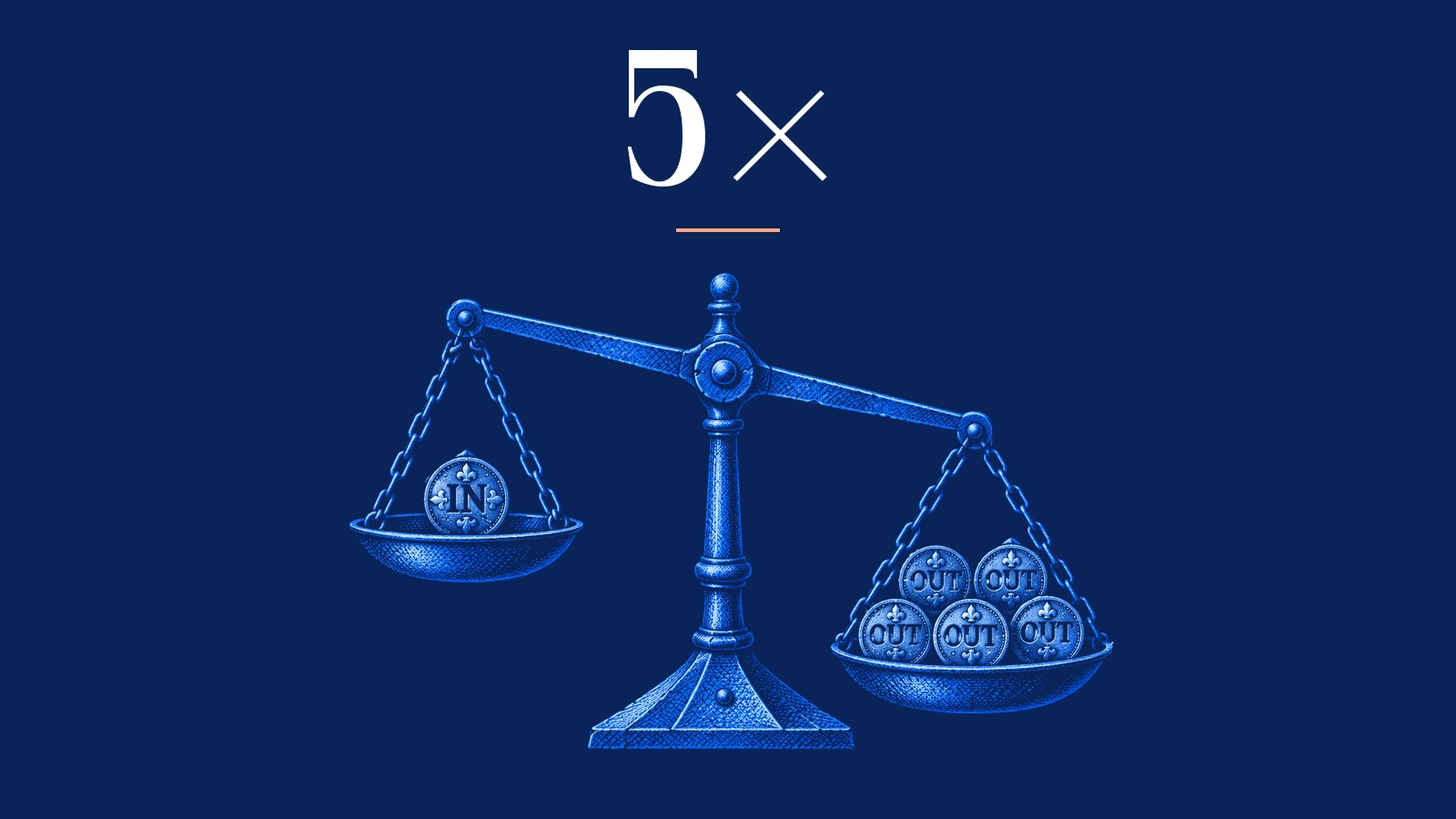
Every current Claude model prices output at five times input: $10 against $2 on Sonnet 5.5, $40 against $8 on Fable 5.2. The model reads your whole prompt in one parallel pass, then writes the answer one token at a time, and each new token needs another pass through the model while the conversation sits in GPU memory. Output holds the hardware longer per token, so Anthropic charges more for it.
Thinking adds to the output side. Anthropic's thinking documentation says the tokens Claude spends reasoning bill as output tokens, even when the API returns no thinking text, and thinking is on by default in the Messages API. The billed output count can run well past the visible reply, so read output_tokens from the usage block and set the effort level per feature.
For a short prompt with a long answer, output drives most of the bill. RAG and agents tilt the other way, because every retrieved chunk and every earlier step goes back in as input on the next call.
How long context, data residency and fast mode change the price
What one call, one user and one customer cost on Claude
Example. A B2B SaaS product sells a $49-a-month plan and runs three AI features on Sonnet 5.5: a chat assistant, a help-center answer built with retrieval (RAG), and an agent that completes a 10-step task. The token counts are assumptions for illustration. Swap in your own from the usage block.
| Call | Input tokens | Output tokens | Cost on Sonnet 5.5 |
|---|---|---|---|
| Chat reply | 2,000 | 400 | $0.008 |
| RAG answer | 8,000 | 600 | $0.022 |
| Agent run, 10 steps | 200,000 | 8,000 | $0.48 |
| Agent run, 10 steps, cached | 200,000 | 8,000 | $0.172 |
Example data. Sonnet 5.5 at $2 input, $2.50 5-minute cache write, $0.10 cache read and $10 output per million tokens.
Chat:   2,000 × $2 ÷ 1M   +   400 × $10 ÷ 1M  = $0.004 + $0.004 = $0.008
RAG:    8,000 × $2 ÷ 1M   +   600 × $10 ÷ 1M  = $0.016 + $0.006 = $0.022
Agent: 200,000 × $2 ÷ 1M  + 8,000 × $10 ÷ 1M  = $0.40  + $0.08  = $0.48
The agent run costs 60 times the chat reply because each of its 10 steps resends the growing context: instructions, tool definitions and every earlier result. Cache that prefix and 170,000 of the 200,000 input tokens bill as cache reads at $0.10, with 30,000 written at $2.50. That's $0.017 plus $0.075 plus $0.08 of output, $0.172 in all, about a third of the uncached run. Claude prompt caching covers when a cache write pays for itself.
What one active user costs
Say an active user sends 20 chat messages and asks 5 RAG questions each working day. That's 20 × $0.008 plus 5 × $0.022, or $0.27 a day. Over 21 working days, one active user costs $5.67 a month.
What three customers on the $49 plan cost
| Customer | Active users | Agent runs | AI cost | Margin | Margin % |
|---|---|---|---|---|---|
| Northwind (light) | 1 | 0 | $5.67 | $43.33 | 88% |
| Birchline (typical) | 3 | 10 | $21.81 | $27.19 | 55% |
| Kestrel (heavy) | 6 | 60 | $62.82 | −$13.82 | −28% |
| Kestrel, agent runs cached | 6 | 60 | $44.34 | $4.66 | 10% |
Example data. Each active user costs $5.67 a month; agent runs cost $0.48 uncached and $0.172 cached.
Kestrel's six users cost $34.02 in chat and RAG, and 60 uncached agent runs add $28.80. Caching the agent's prefix brings Kestrel back to a $4.66 profit. Moving chat to Haiku 5.5 would go further: the same 2,000-in, 400-out reply costs $0.0004 there, a twentieth of the Sonnet price, and Haiku vs Sonnet covers where the cheaper model holds up.
Averaged across all three, the plan looks healthy: $90.30 of AI cost against $147 of revenue. Lancelot prices every call at the model's rate for the day it ran and shows cost and margin per customer, so Kestrel appears by name instead of hiding in the average (Margin intelligence).
Questions about Claude API cost
How much does the Claude API cost per million tokens?
Sonnet 5.5 costs $2 per million input tokens and $10 per million output tokens. Opus 5.5 costs $4 and $20, Fable 5.2 costs $8 and $40, and Haiku 5.5 starts at $0.10 and $0.50, rising to $0.50 and $2.50 for prompts over 100,000 tokens.
How do I calculate Claude cost per token?
Divide the per-million price by 1,000,000, so Sonnet 5.5's $10 output price is $0.00001 per output token. Then multiply each count in the response's usage block by its rate and add input, cache writes, cache reads and output together.
What is the difference between input and output tokens?
Input tokens are everything you send: system prompt, conversation history, retrieved documents and tool definitions. Output tokens are everything Claude writes, including thinking you never see. Every current Claude model charges five times more for output than for input.
How many tokens is a word in Claude?
About 1.8 tokens per English word on current models. Anthropic says 1 million tokens hold about 555,000 words on the tokenizer introduced with Claude Opus 4.7, and older models fit about 750,000. Use the token counting endpoint for exact numbers.
Is the Claude API cheaper with batch processing?
Yes. The Batch API charges 50% of the standard price on both input and output, so Sonnet 5.5 drops to $1 and $5 per million tokens. Batch requests run in the background, and the discount stacks with prompt caching.
How much does the Claude API cost per customer each month?
It depends on calls per customer. In a worked example on Sonnet 5.5, a customer with one active user cost $5.67 a month, and one with six users and 60 agent runs cost $62.82, more than a $49 plan brings in.
Does Claude charge more for long context?
Fable 5.2, Opus 5.5 and Sonnet 5.5 charge standard rates across the full 1 million-token context window. Haiku 5.5 charges five times its base rate on input and output for any request whose prompt passes 100,000 tokens.
Per-token prices set the floor. Prompt size, thinking effort and a few heavy customers decide the rest of the bill, and our guide to cutting LLM costs covers the levers for each.