Token counts and revenue are all it needs. Here’s what it can reach, where it keeps it and who can change what.

AES-GCM encryption on every connection key and channel secret.
roles per member: Owner, Admin, Member and Viewer.
minute or less before a revoked API key stops working.
Stripe write endpoints Lancelot ever calls.
writes your browser can make to the database. Every change goes through Lancelot’s server.
Ask before you connect anything. The answers match what the app does today.
You make the key in Stripe, RevenueCat or your AI provider, with only the access the job needs.
A revoked API key stops working within a minute. Disconnecting deletes the key.
Keys and channel secrets use AES-256-GCM. API keys are stored only as hashes.
Token counts, the model and a customer ID for each AI call. Never prompts or responses.
A restricted key that reads customers, subscriptions and invoices. Lancelot rejects full secret keys and never calls a Stripe write endpoint.
A secret key used to read purchases and subscriptions. Production data only.
Optional. An admin key, used only to read your OpenAI and Anthropic cost reports.
Your app calls your AI provider directly. Lancelot gets the counts afterward, in batches.
Every table checks which workspace you belong to. Your browser can read your own data but can’t write to the database.
Stripe, RevenueCat and provider keys, and channel secrets, are encrypted with AES-256-GCM. API keys are stored only as hashes.
A revoked API key stops working within a minute. Disconnect a provider and Lancelot deletes its key.
Loads only its own scripts, can’t be framed by another site and always uses HTTPS.
The app runs on Vercel and the database on Supabase, both in the United States.
Everything, including billing and deleting the workspace.
Settings, team, integrations, the agent’s kill switch and the audit log.
Approve and undo agent actions, and create API keys.
See the workspace and change nothing.
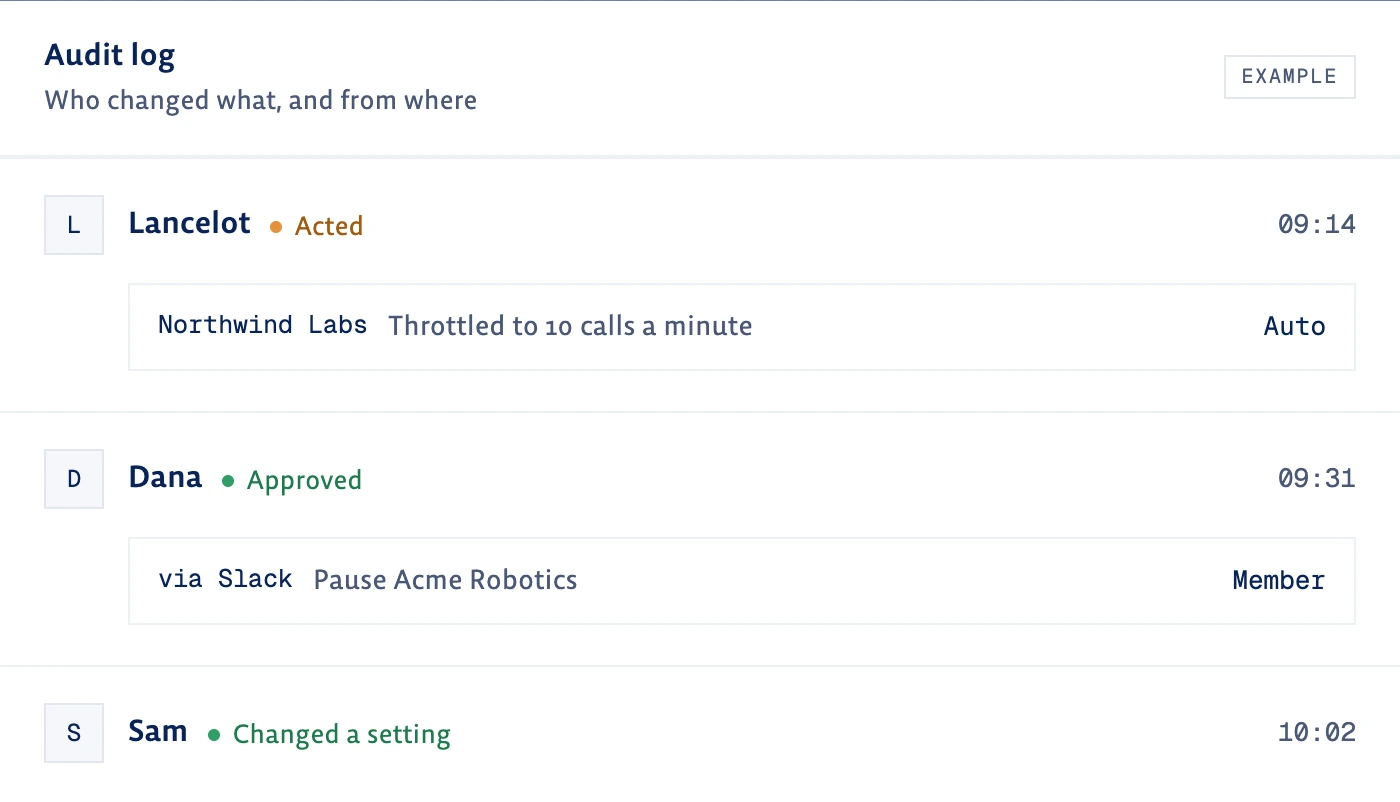
Agent actions, approvals and undos, and changes to settings, team, integrations and billing.
A teammate, Lancelot or an API key, with the email at the time.
The app, Slack, email, Telegram or the API.
In Settings, with CSV export.
For the life of the workspace.
Database and sign-in. Everything in your workspace.
Hosting, scheduled jobs and app analytics. Requests to the app and API, and page views.
The agent’s diagnosis. Costs, plans and customer IDs, with no names or emails.
Lancelot’s own billing. Your workspace name, billing email and payments.
Email. Alerts and briefings you subscribe to.
SMS, if you add it. Alerts to your phone.
Channels you connect. Alerts and approvals.
Error reports. Page path and error message.
Product analytics. Setup steps, keyed by workspace ID.
For each AI call: token counts, the model, a customer ID and an optional feature name. From Stripe or RevenueCat: revenue, plans and invoices. Never the text of your prompts or responses.
No. The SDK wraps your OpenAI or Anthropic client inside your app, so every call goes straight to the provider. Lancelot gets the counts afterward, in batches.
Your AI calls keep running. The SDK holds events in memory and retries. If you turned on limits, the last ones it received stay in place until it reconnects.
Lancelot asks for a restricted key with read access, rejects full secret keys and never calls a Stripe write endpoint. Its own billing uses a separate key.
In the United States, on Supabase and Vercel.
Yes, from Settings or the API. Lancelot replaces their ID with a pseudonym, clears their name and email and keeps the totals, so your margins don’t change.
Not yet. Send us your security questionnaire and we’ll answer it.
Not yet. Your team signs in with email and a password or one-time code, or with Google or GitHub.