The SDK sends token counts, the model and who made each call. Your prompts and responses stay in your app.

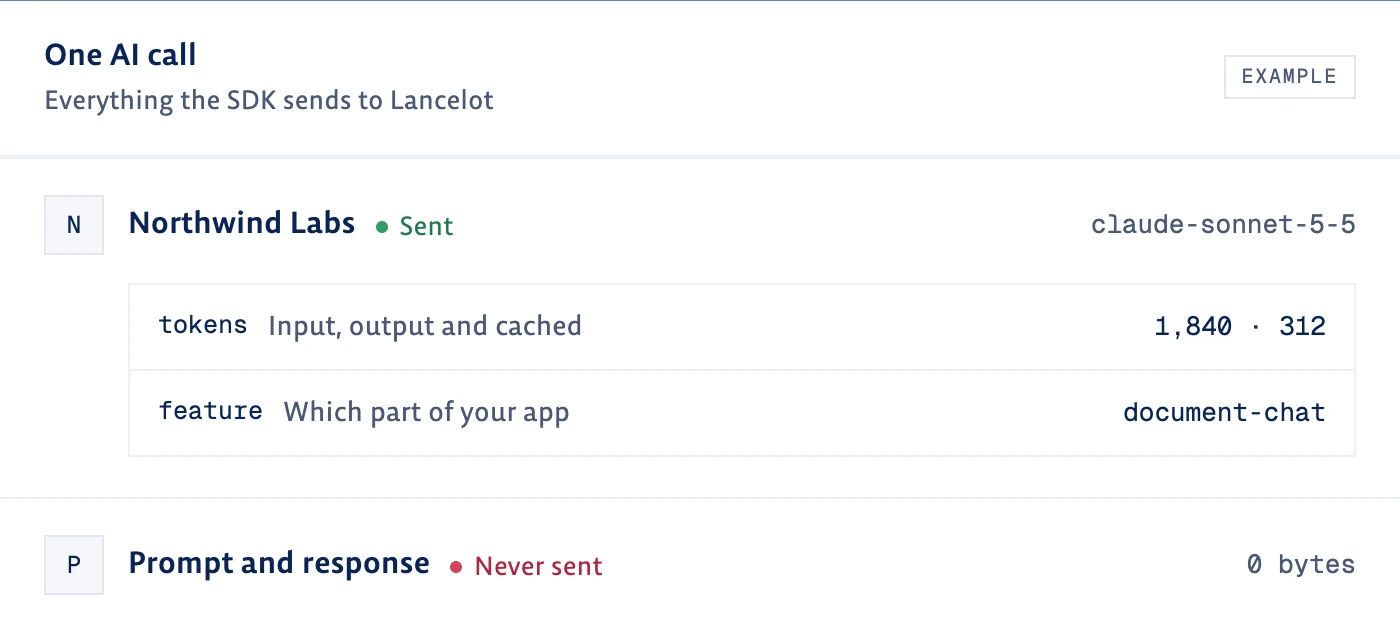
fields per AI call: who, which model, tokens, feature, time and response ID.
months before raw usage events are deleted.
days that notification records are kept.
payment card numbers Lancelot sees.
bytes of prompt or response text in anything the SDK sends.
Lancelot removes customer names and emails before anything reaches its AI model.
Erasing a customer replaces their ID and clears their name, email and your notes.
Your margins don’t move after an erasure.
Deleting the workspace removes everything in it, after typing its name.
Who made the call, as you name them. Use an internal ID to keep emails out.
Which provider and model answered.
Input, output, cached and cache-write counts.
Optional. Which part of your app made the call.
When the call happened.
The provider’s response ID, so a retry never counts twice.
From each reply, the SDK reads only the token counts, the model and the response ID.
There’s no proxy. Your calls go from your app straight to OpenAI or Anthropic.
Lancelot reads invoice totals from Stripe. It never sees payment cards.
Helicone imports leave inputs out. OpenRouter and OpenTelemetry traces are read for their counts, and their content is never stored.
Customer name, email and ID, live subscriptions and paid invoices, with a restricted key that has read access.
Store, product and proceeds for each purchase. No names or emails. Production data only.
If you turn on bill matching: daily cost and usage by model, with an admin key used only to read cost reports.
Costs by day, feature and model, the customer’s plan and revenue, past actions and your workspace notes.
Customer names and emails.
Sent as you set it. Use an internal ID to keep emails out.
Your data isn’t used to train AI models.
13 months.
The life of the workspace, so your history keeps working.
30 days.
The life of the workspace.
From Settings or the API. Their ID becomes a pseudonym in customers, findings and actions, their name, email and notes are cleared, and totals stay.
The owner can delete it after typing its name, and everything in it goes.
No. The SDK reads only the token counts, the model and the response ID from each reply, and Lancelot’s server drops any field it doesn’t expect.
In two cases. It asks OpenAI to include token counts in streamed replies, and it switches a customer to the cheaper model you approved if you turned on limits.
You can, and it makes customers easy to recognize. To keep emails out of Lancelot, use your own internal ID or the Stripe customer ID instead.
Only if you connect Stripe, which includes them in each customer record. RevenueCat doesn’t share them, and Lancelot never sends them to its AI model.
Raw events for 13 months. Daily totals stay for the life of the workspace, so your history keeps working.
Yes, from Settings or with the API. Lancelot replaces their ID with a pseudonym, clears their name, email and the notes about them, and keeps the totals so your margins don’t move.
Lancelot deletes everything in it. Only the owner can do this, after typing the workspace name.
Connection keys and channel secrets are encrypted with AES-256-GCM, API keys are stored only as hashes, and everything travels over HTTPS.