Each day, Lancelot lines your OpenAI and Anthropic bills up with the usage it tracked per customer, and explains every gap.

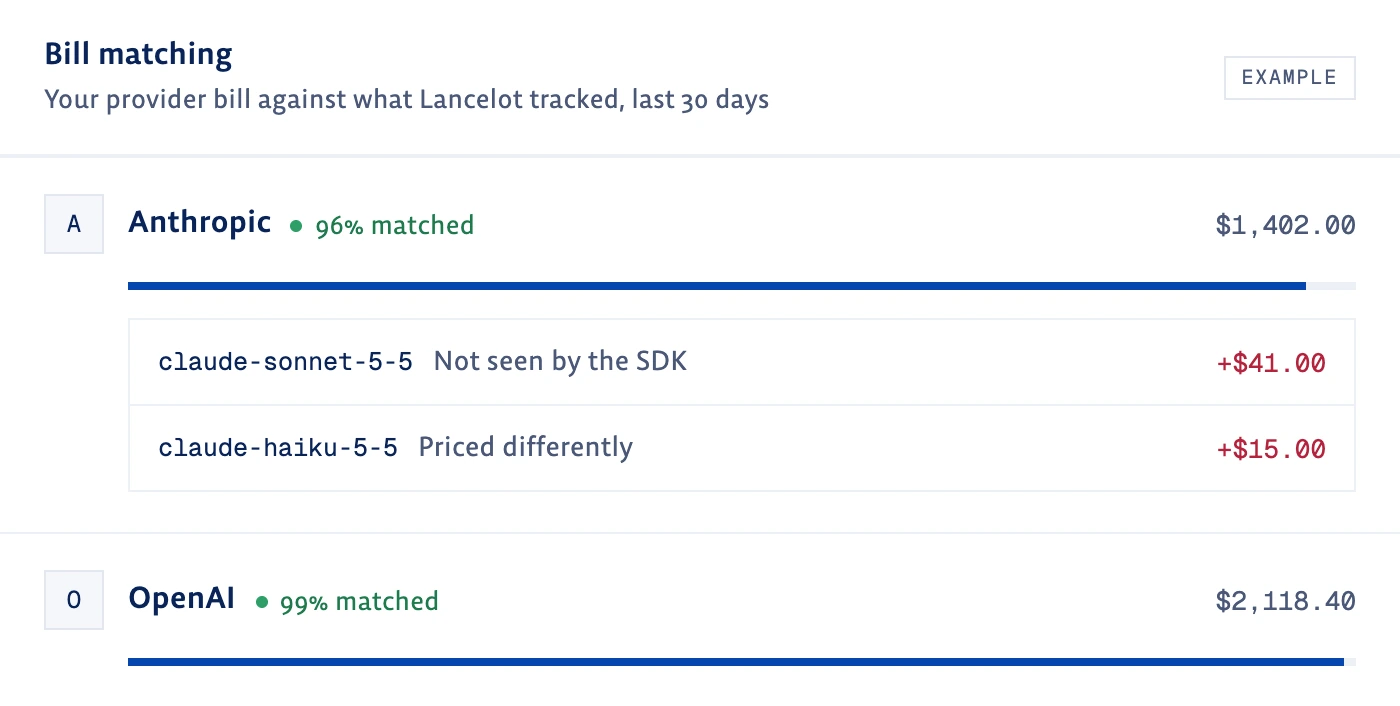
check a day, at 04:45 UTC.
days re-read each time, because providers revise recent usage.
of a day’s bill, or 50 cents, still counts as a match.
and 5% of a settled week before Lancelot alerts you.
of this example bill tied to a customer.
Per-customer cost adds up to what you paid, so a finance lead can check it without digging through usage logs.
An OpenAI or Anthropic admin key, stored encrypted and used only to read cost reports.
Lancelot reads the provider’s own report and matches it day by day, model by model.
Remove the key and Lancelot deletes it, along with the bill data it read.
Once a day at 04:45 UTC, through each provider’s usage and cost reports.
The last 8 days, every time, because providers revise recent usage.
A dated model ID and its alias count as one model, so claude-sonnet-4-5-20250929 and claude-sonnet-4-5 never show as two gaps.
A difference within 2% of that day’s bill for the model, or 50 cents, whichever is larger.
Web search and code execution get their own line and never count as a gap.
Left out, because OpenRouter bills them, not OpenAI or Anthropic.
The share of the bill’s dollars tied to tracked usage over the last 30 days, for each provider.
The 7 days ending 2 days ago, since providers can take a day to finalize usage.
Over $5 and over 5% of that week’s bill.
One paragraph per provider: billed, tracked, the matched share and the top three gaps.
Gaps over $100.
The finding resolves once the gap closes.
Matched share and explained gaps let a finance lead check per-customer margins against the invoice, without exporting usage logs. It works before you have a FinOps team.
An Admin API key from Claude Console, under Settings → Admin keys. It starts with sk-ant-admin. A regular API key won’t work, and Lancelot tells you so.
An Admin key from the OpenAI dashboard, under Organization → Admin keys. Project keys won’t work.
Stored encrypted and used only to read usage and cost reports.
Lancelot stops checking and shows “Key rejected” in Settings until you reconnect.
Anytime, from Settings.
It reads your OpenAI and Anthropic bills and compares them, day by day and model by model, with the AI usage Lancelot tracked per customer. You see what share of the bill is tied to customers, and a plain explanation for every gap.
The OpenAI usage dashboard shows what your organization spent by day and model, but it doesn’t know your customers. Lancelot lines that same data up with the calls it tracked per customer, so you see how much of the bill you can tie to a customer and why the rest differs.
OpenAI and Anthropic, through their own usage and cost reports. Google Gemini isn’t supported for bill matching yet. Usage from other providers that you send to Lancelot still counts in your margins, but it isn’t checked against a bill.
An Admin key from your Claude Console or OpenAI organization, because only admin keys can read usage and cost reports. Lancelot uses it only to read those reports. It’s stored encrypted, and you can disconnect it anytime.
A difference of 2% of a day’s bill for a model, or 50 cents, whichever is larger, counts as a match. Anything bigger is labeled as usage Lancelot didn’t see, a price difference, or more tracked than billed.
The provider billed tokens that Lancelot never saw. Usually a script, a batch job or another service is using the same API key outside your app. Wrapping those calls with the SDK closes the gap.
Once a day. Lancelot re-reads the last 8 days each time, because providers revise recent usage for up to a day, and alerts you about a settled week that ends 2 days ago.
No. Lancelot raises a gap only when the unexplained difference over the week is more than $5 and more than 5% of the bill. Gaps over $100 are marked urgent.
Yes. The matched share shows how much of each invoice Lancelot ties to customers, so a finance lead can check per-customer cost against what you paid without digging through usage logs.
It covers the part finance asks about first: whether AI cost ties out to the invoice, and which customers it belongs to. Lancelot also shows margin per customer and plan. It doesn’t manage cloud spend or reserved capacity.